“I learned more about cap rates in 5 minutes reading your Cap Rate paper than in all my studying up to that point.
GregToolbox Customer · Chicago
“I used the Appraisal Toolbox for two classes and found every practice problem I could dream of! For my State exam, I’ve been using the Exam Portal…every topic is covered…easy to understand and well worth the investment.
TinaToolbox Customer · Chicago
“The appraisal toolbox is one of those rare websites that you can find that truly does what it advertises and does so extremely well. The site is intuitive and easy to navigate while providing questions and explanations better than the course materials. An absolute must use for any appraiser.
XavierToolbox Customer · Taylorsville, KY
“The Appraisal Toolbox is such a user friendly supplement to any appraisal training class. It regenerates problems so you can really dig deep on problem areas, and it’s math heavy where other study guides are not. I actually learned when to use equations instead of blindly memorizing them. It’s amazing to have all the information in one place and ready to go before tests or even in the field. Highly recommended!
StephanieToolbox Customer · Chicago
“The Appraisal Toolbox was a huge help while I was studying for my Certified General course exams. The material was easy to follow, well organized, and covered the topics I needed to focus on. Being able to work through everything at my own pace made a big difference, especially while working full time. I’d definitely recommend it to anyone working toward their appraisal license.
ChristianToolbox Customer · Tulare, CA
“For the Certified General Income Part 2 course, our instructor (Joe) offered the Appraisal Toolbox as an additional tool along with the course. I found this toolbox very instrumental in my success in passing the exam. The way the toolbox is laid out: starting something basic and elevating up with each lesson.
ChrisToolbox Customer · Chicago
“The Appraisal Toolbox is awesome! Very user-friendly, easy to navigate, and loaded with practice problems that really helped reinforce the material. Working through the questions made me much more confident going into my Income Cap II exam. I’d definitely recommend it to other appraisal students.
Dwayne “Champ”Toolbox Customer · New York
“Those Toolbox questions were a lifesaver and honestly helped me way more than the practice problems in the coursebook.
GarrettToolbox Customer · Boston
“Cool site; this will revolutionize learning the appraisal curriculum. Hands down: best appraisal teaching tool out there and a must for every student at every level.
Pick the style of problem you want to preview. Full step-by-step solutions, HP12c keystrokes, graphs to illustrate results, and solution roadmaps. And, every problem has a "New Problem" button...keep working the problem until you master it!
See the Difference
We’ve all been here…
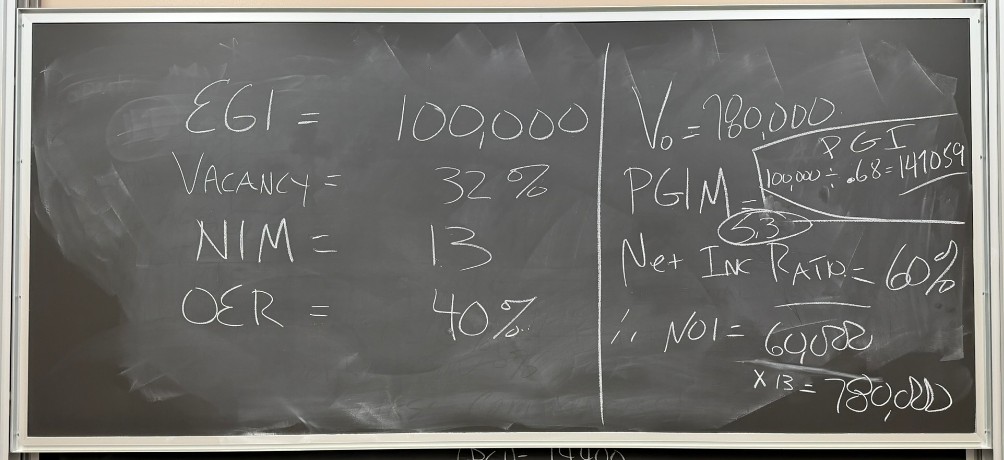
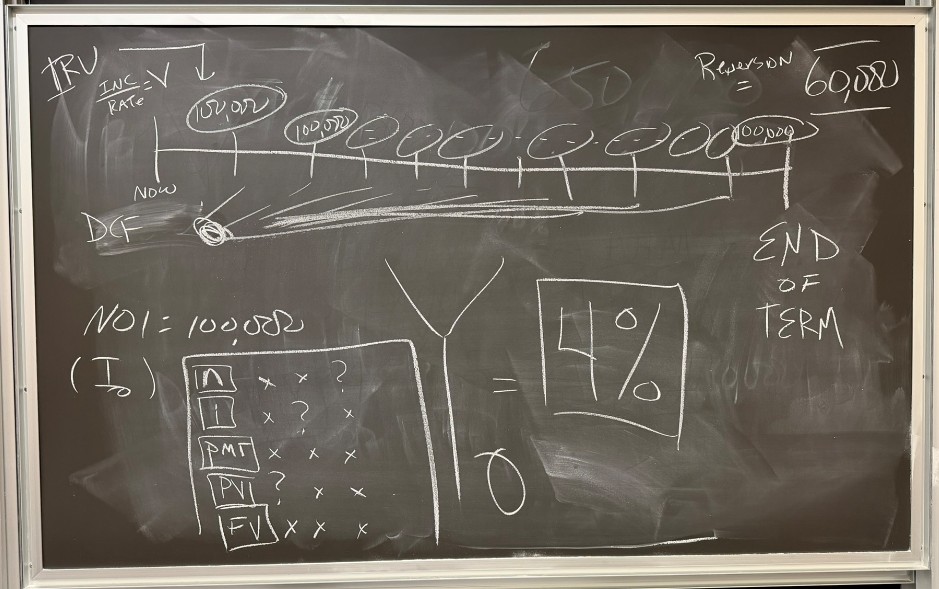
Appraisal concepts and keystrokes taught on a chalkboard — scribbled, smudged, and erased before you finished copying. The fundamentals haven’t changed, but the way to practice and master them has.
ThenWe’ve all been here…
Now…now imagine a better way.
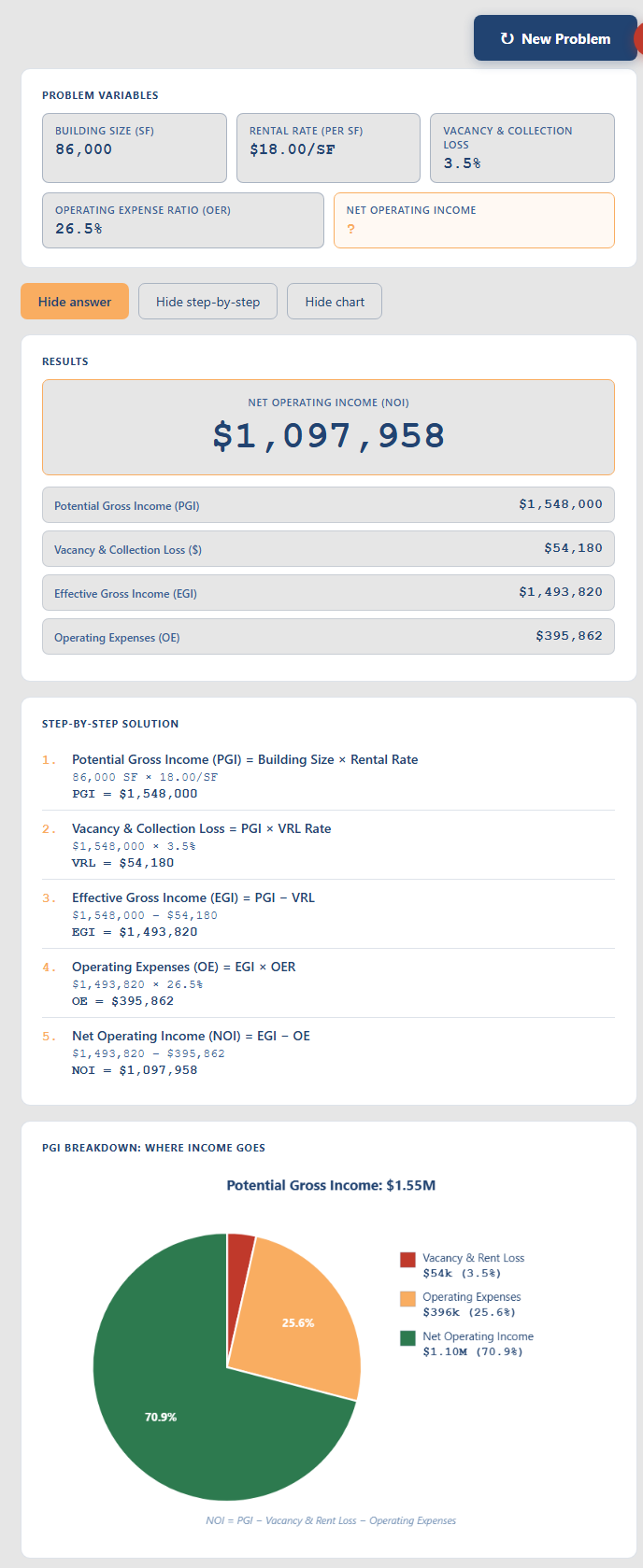
Income Approach — NOI & Valuation
ThenWe’ve all been here…
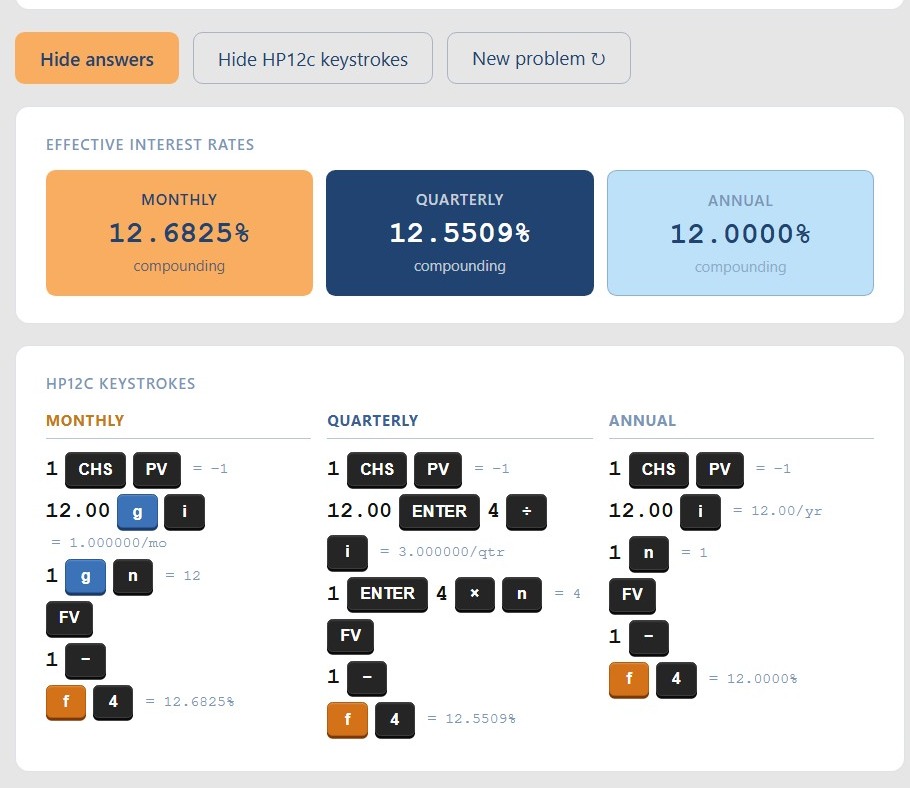
Now…now imagine a better way.
HP12c — Keystrokes That Actually Help
New Content … Coming Soon!!
New topics released weekly.
Provide us with ideas for new topics!
Our Videos
Short. Simple. Easy to follow.
300 videos across three formats — learn the full concept, brush up in 5 minutes, or get a 1-minute HP12c keystroke fix. Your pace, your depth, your time.
230videos
Teach Me
Full Video Learning
Step-by-step instructions. We don't read the book to you — we explain the material to you. In-depth detail with working problems, spreadsheet solutions, and HP12c keystroke solutions to download. Every component of the three approaches to value, plus litigation, eminent domain, specialty assignments, partial interests, how to competently review an appraisal, and more.
50under 5 min
Remind Me
Quick Refreshers
Quick, "to the point" summaries of various topics for the individual who knows the subject, but needs a brief reminder of the steps or process. Maybe you don't need the full detailed explanation of what an internal rate of return is — you just need a quick (under 5 minutes) refresher before an exam or client meeting.
20under 1 min
Help! I Forgot
HP12c Keystroke Solutions
Most appraisers rely on their financial calculator as the lifeline to credible (and correct!) assignment results. HP12c quick keystroke solutions for mortgages, balloon payments, sinking fund factor, "change in value" as a percentage, coefficient of correlation, mean, standard deviation, IRR, NPV, and many more.
Member Access
FREE, UNLIMITED Access
Sign up as a member and get everything you need to learn, practice, and produce professional appraisal work — at no cost.
✓
Instructional videos, informational videos
✓
Practice problems (solutions explained with video link for step-by-step)
✓
Calculator solutions and programming
✓
Fully functional Excel worksheets
✓
Fully functional Google Sheets (great for collaboration)
✓
Mini case studies (excellent tools for students preparing for exams)
✓
Appraisal report — section/topic templates
✓
Appraisal review report — section/topic templates
✓
Engagement letter — templates
What students say
Used alongside real course material
A must for any course
Joe has developed his own website with the course-related examples and materials, which are definitely useful. I suggest to include those into the updated version of the course.
Enhances learning
Using the course material in addition to the private material, TheAppraisalToolbox.com, for practice problems, study materials, and videos to assist with concept development, understanding, and mastery.
Easy to use
Loved Joe's website and his practice problems. Provided supplemental and independent course material for concept application and reinforcement.
In-depth concepts
The instructor provided in-depth conceptual material. TheAppraisalToolbox.com was extremely helpful.
Extra practice
Provided extra work with problems and solutions to reinforce concepts.
Educational and informational videos, Excel and Google Sheets downloads for many appraisal solutions, practice problems to sharpen your skills and prepare you for exams, HP12c calculator solutions, shortcuts, and programs. For more info, watch this short video!
Most of the content is free. However, subscribers have access to a wide range of practice problems, solving short problems, multiple choice questions, matching problems… developed to prepare you and test you for any course you might be taking.
Appraisers, students and instructors of appraisal courses, review appraisers, clients, attorneys, and individuals looking for information about valuation services.
Every real estate valuation topic is taught — from basic definitions and concepts through advanced income capitalization and market analysis techniques.
Our easy-to-use search features allow you to search by a word or text string. Type "income capitalization" — and links to 37 videos appear!
No! We offer many videos on brokerage issues (selling a home, marketing your property), title insurance issues (what is title insurance and how does it impact property valuation), tenant and landlord issues, what to consider when hiring an appraiser, how appraisers assist in litigation, real estate tax and assessment issues, and much more!
The lengths of our videos vary by topic. However, most videos dealing with valuation methodologies (example… how to measure depreciation) are presented in two versions: (1) "Teach Me" — a step-by-step presentation; and (2) "Remind Me" — a quick overview of the procedures.
First, we provide information on nearly every special-purpose type (quarries, dairy farms, intermodal facilities, medical office buildings), assignment type (pipeline easements and damages, conservation easements, partial interests, feasibility studies, market research), and litigation issues (finding a qualified appraiser, what makes an appraiser competent, how to develop a scope of work agreement to protect you, how to prepare for trial, overview of expert testimony for litigation assignments), etc. Second, email us a topic or question and we will present a video for you addressing your specific situation!
We offer numerous videos addressing appraisal reviews. Whether you are an appraiser developing a formal review opinion for compliance with USPAP, a client trying to "understand" the appraisal report and opinions, or an attorney looking for assistance on an expert's report dealing with advanced techniques and analysis, we have the answers for you. Search our list of video titles by "review" and you'll find your answer!
The videos are developed to supplement learning, provide general information for appraisers and users of appraisal services, and offer reviews for information that you might have covered in valuation courses — but you need a quick refresher.
Online modules allow you the opportunity to read material (teach yourself) and sit for an exam! Regardless of the module, topic, or content being covered, we have videos and practice problems developed to assist you with specific module material intended to prepare you for your exam.
Without question! Our material includes "overviews" of topics for quick refreshers.
Yes. If, for example, you are getting ready to take a course dealing with the cost approach and depreciation scares you, we have multiple videos to breakdown the process and explain every aspect of the depreciation models (age/life methods, market extraction method, the breakdown method) so the upcoming course will be a breeze!! Relax! No more anxiety during the week of the class as the exam approaches!
We are appraisal course instructors, and we feel your pain! Let us simply clarify the concepts for you (with examples and illustrations) so there is no more confusion.
Our report-writing expert will not only walk you through ways to be sure your reports comply with professional standards (USPAP), but will also show you some great ideas for enhancing your reports with the effective use of exhibits, tables, charts, etc.
Watch our videos dealing with Excel. We show you, step-by-step, how to simply add information into a table (worksheet) and after a few clicks here and there … a professional looking chart shows your data! You'll be an expert in graphs in no time at all!
You are not alone! Our resident "statistics expert" will walk you through the basics (terminology, concepts, an overview) and show you how to use some advanced features (in Excel and on your HP12c calculator) QUICKLY AND EASILY! Lastly, you will learn how to use charts and graphs to effectively communicate the results of your work.
[Please send the full answer for this one — it was collapsed in the screenshot.]
You are at the right place. From our "PRACTICE PROBLEMS" menu, pick a category (example… cost approach) and then pick a topic (example… estimating functional obsolescence) and multiple practice problems appear — developed to test you on the proper problem-solving process. Our solutions sheet explains each step in the process.
Not only will we show you — very simply — what the DCF process is, but we will also provide you the tools to do your own "sensitivity analysis" so you can see the impact on the value conclusion by changing the variables. What the appraiser is NOT telling you is that even subtle changes to the inputs could have significant impacts to the conclusion!
[Please confirm this question wording — I pieced it together from the visible tail of the answer.] … in the review process. We will teach you to "think like a reviewer" before submitting your report.
Our team includes an attorney SPECIALIZING in this issue. While she will not be able to give "legal advice" for your specific circumstances, she will explain to you basic issues and how to get them resolved.
Our team includes an attorney SPECIALIZING in this issue. Let our expert explain to you the process, your rights, and how to prepare for what lies ahead. Can you get your own witnesses (independent reviewers) to use in your defense? Should you hire an attorney? We'll address all of the above — and much more!
Our team includes experienced attorneys and appraisers who will walk you through the litigation process and explain your next step. Do you need an attorney? Should you contact the original client? What about all of the confidential information in your file? What if you signed an NDA (non-disclosure agreement)? What if you are going to be on vacation when you are "ordered" to appear? Let us explain all of this to you!
Maybe nothing … maybe everything! The court has their own "rules" regarding admissibility of evidence and testimony. Let us explain.
Get in touch
Send us a note — or a suggestion
If you have ideas for another topic or additional information on one of our existing topics, we'd love to hear from you.
Reach us directly
Experienced presenters — easy-to-learn. Prefer to call or email? Here's how:
A well-maintained single-family residence recently sold for $813,000. The property includes a roof replaced 9 years ago and hardwood floors throughout the main level. Based on comparable land sales, the site value is $220,000. The cost to construct the improvements as new would be $670,000. The property is 10 years old.
Show answerShow 10-step solutionShow graphsNew problem ↻
Sale Price Composition
Site Value27.1%
Building Depreciation0.5%
Building Value (Undepreciated)72.5%
Word ProblemVariables Only
Site Valuation and Cost Approach
Depreciation — Market Extraction Method
Problem Variables
Sale Price
$813,000
Land Value (Site Value)
$220,000
Cost of Improvements (New)
$670,000
Age of Property
10 years
Implied Total Economic Life
Solve via 10-step extraction
3
Our Tools
Step-by-Step Solutions
BETA
Explanation of Incurable Depreciation — Short-Lived Items
► CLICK HERE
Building Components
Roof
Age14 yrs
Useful life16 yrs
Cost$5,900
Show Roof Calculation
(age ÷ useful life) × cost
(14 ÷ 16) × $5,900
= 0.8750 × $5,900
Roof depreciation = $5,163
HVAC
Age20 yrs
Useful life35 yrs
Cost$16,000
Show HVAC Calculation
(age ÷ useful life) × cost
(20 ÷ 35) × $16,000
= 0.5714 × $16,000
HVAC depreciation = $9,143
Carpet
Age6 yrs
Useful life8 yrs
Cost$3,400
Show Carpet Calculation
Water Heater
Age7 yrs
Useful life15 yrs
Cost$900
Show Water Heater Calculation
Show answerShow step-by-stepShow graphsNew problem ↻
Step-by-Step Solution
1.Roof: (14 ÷ 16) × $5,900 = $5,163
2.HVAC: (20 ÷ 35) × $16,000 = $9,143
3.Carpet: (6 ÷ 8) × $3,400 = $2,550
4.Water Heater: (7 ÷ 15) × $900 = $180
Total Incurable Depreciation = $17,036
Component Comparison
Roof$5,163
HVAC$9,143
Carpet$2,550
Water$180
Total$17,036
Depreciation by Component — All Four Items
Roof
87.5%
HVAC
57.1%
Carpet
75.0%
Water Htr
46.7%
Combined
60.4%
4
Our Tools
You Select the Graph
BETA
Market Extraction — Multiple Properties
► CLICK HERE
Comparable Sales
Comparable Sale A
Sale price$573,300
Age12 yrs
Cost new$443,500
Site value$220,000
Eff. age13.6 yrs
Hide answer
Comparable Sale B
Sale price$645,800
Age18 yrs
Cost new$476,000
Site value$238,000
Eff. age9.3 yrs
Hide answer
Comparable Sale C
Sale price$415,000
Age28 yrs
Cost new$312,000
Site value$186,000
Eff. age13.7 yrs
Hide answer
Implied Total Economic Life
Property A67.1yrs
Property B65.2yrs
Property C51.4yrs
Chart type
Effective Age vs DepreciationImplied Econ Life by Property▾
Effective Age vs Depreciation
Total Cost by Property
Depreciation per Year
Implied Econ Life by Property
Reading this chart: The shaded band shows the typical economic life range for buildings (about 50–70 yrs). The closer your comparables cluster within that band, the more confidence in the rate you would apply to your subject property.
5
Our Tools
Reshuffle the Problem Variables
BETA
Calculate Property Value — Cost Approach
► CLICK HERE
Calculate the total property value using the cost approach.
Building Dimensions & Cost
Building width (ft)
30 ft35 ft28 ft32 ft
Building depth (ft)
40 ft45 ft38 ft42 ft
Number of stories
3243
Cost per square foot
$98$112$86$104
Local cost multiplier
1.151.101.201.18
Current cost mult.
1.051.081.031.06
Entrepreneurial inc.
12% of cost new15% of cost new10% of cost new13% of cost new
Site improvements
$9,800$7,400$11,200$8,500
Depreciation
Effective age
18 yrs22 yrs14 yrs20 yrs
Remaining economic life
30 yrs28 yrs35 yrs32 yrs
Land
Land size (acres)
0.18 ac0.25 ac0.21 ac0.19 ac
Land value (per SF)
$3.65/SF$4.20/SF$3.45/SF$3.85/SF
Show answerShow step-by-stepNew problem ↻
6
Our Tools
Take a Quiz
BETA
Cost Approach — Depreciation (Multiple Choice)
► CLICK HERE
Question 1 of 50Score: 0 / 0
Question 1
The effective age is 9, the economic life is 50, and the age is 15. What is the implied amount of annual depreciation on a straight-line basis?
A21%
B18%
C2%
D13%
Correct!
Hint
To solve implied annual depreciation, you only need to know one thing about the property: its total economic life. Think of a property's total life as being 100%.
100% ÷ 50 years = 2%. The full life of the building (100%) divided by the total economic life (50 years).
HintHide HintNext Question →
License Required
This section is part of the licensed course library. You can preview a sample problem for free, or choose a course package to unlock everything.